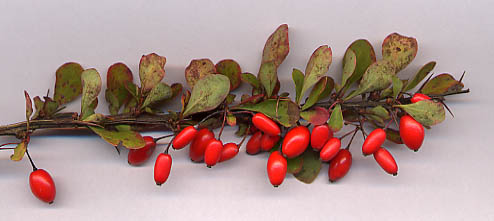
Specimen record
Japanese Barberry
Berberis thunbergii
Conservation note
Invasive species — collection encouraged. Known to increase habitat suitability for Lyme disease-carrying ticks.
Invasive species
This plant is non-native and invasive. Collection is encouraged. Invasive species — collection encouraged. Known to increase habitat suitability for Lyme disease-carrying ticks.
Description
An invasive deciduous shrub from Japan widely planted as an ornamental but now escaped into woodlands throughout the northeast. It forms dense, impenetrable thickets that exclude native vegetation and is associated with increased tick (Lyme disease) populations.
Identification tips
- 1Single sharp spines at each node
- 2Small spatula-shaped leaves in clusters at spine nodes
- 3Bright red elongated berries persisting through winter
- 4Twigs with distinctive orange/yellow inner bark when cut
- 5Dense, arching, spiny branches
Specimen & preservation notes
Collect with gloves — spines are sharp. Press leafy branches with berries when available. Good for showing invasive shrub characteristics.
Collection calendar
| Wk | Apr | May | Jun | Jul | Aug | Sep | Oct | Nov |
|---|---|---|---|---|---|---|---|---|
| 1 | ||||||||
| 2 | ||||||||
| 3 | ||||||||
| 4 |
Collection notes
Season check
Observed bloom also extends into April.
Flowering records: 105 iNaturalist observations, Massachusetts · Nearby: 1001 observations within 25 km